
Written by Chad & Millie of Root Freedom
Most people picture mulberry as a messy ornamental tree that stains sidewalks purple every spring. But the real wild mulberry benefits come from Texas’s own native mulberry species — and if you’ve got a tall one shading a creek bank on your property, there’s a good chance it’s not the introduced yard variety at all, but Red Mulberry, a genuinely native tree with generations of traditional use behind it.
Quick Answer
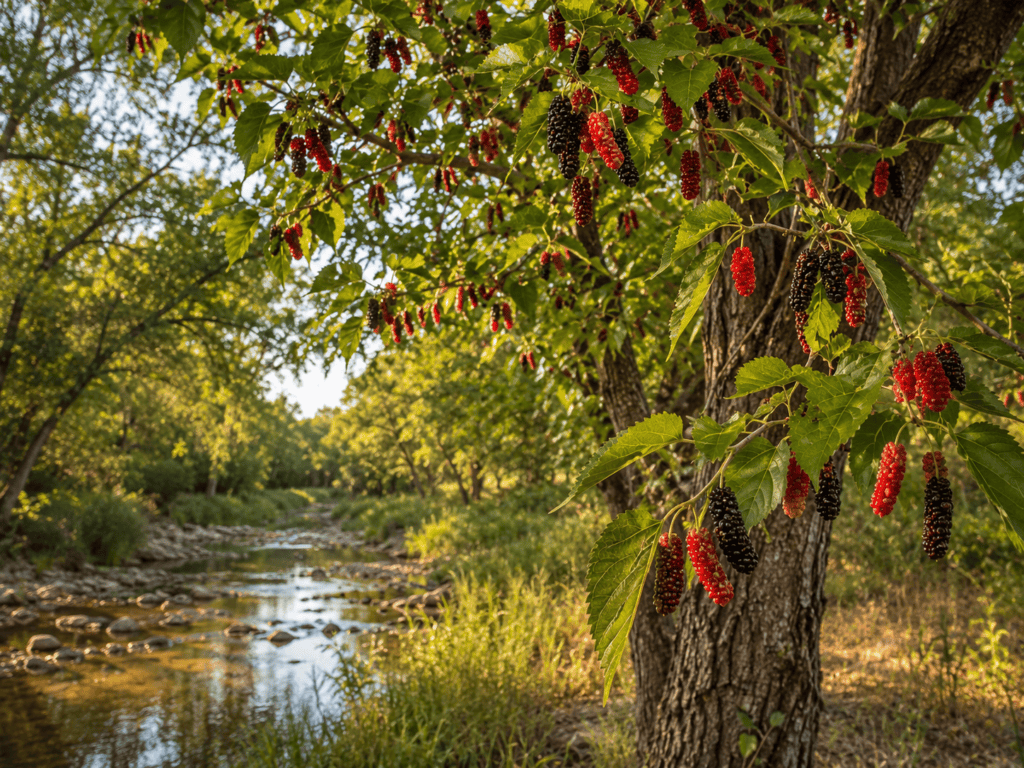
Red Mulberry (Morus rubra) is a native tree found across East and Central Texas, typically growing 30 to 60 feet tall in the rich, moist soil of creek bottoms, riverbanks, and floodplains. Its berries ripen in late spring, generally May into June, forming an elongated, blackberry-like fruit that turns from red to dark purple-black when ripe. The ripe fruit is edible and nutritious, with a long history of use by Native Americans and early settlers, while the bark and root carry their own traditional uses as well. Unripe fruit is best avoided.
What You’ll Learn
- What Red Mulberry is and how it differs from the mulberry trees planted in most yards
- Traditional and folk uses of the fruit, bark, and root
- What research says about mulberry’s nutritional and antioxidant properties
- How to safely identify and harvest wild mulberry
- South Texas specific foraging notes
- Important safety considerations before trying it
Understanding Wild Mulberry Benefits
Texas is home to two native mulberry species — Red Mulberry (Morus rubra), a medium-to-large tree found across East and Central Texas, and Texas Mulberry (Morus microphylla), a much smaller tree found further west. What most people plant in their yards, and what stains sidewalks purple every spring, is usually White Mulberry (Morus alba), an introduced species from Asia with smoother, glossier leaves and rounder fruit.
Red Mulberry is a real tree, not a shrub — commonly 30 to 60 feet tall with a trunk up to two feet across and a broad, spreading crown. It favors exactly the kind of habitat you’d find along a creek bank: rich, moist bottomland soil, often growing as an understory tree beneath larger hardwoods. The leaves are large, up to 8 or 9 inches long, rough on top and soft underneath, and notably variable in shape — a single tree can have unlobed, mitten-shaped, and multi-lobed leaves all at once, which throws off a lot of people trying to identify it. The bark is thin, dark grayish-brown, and peels in long narrow strips, and the tree carries a mild milky sap that shouldn’t be swallowed.
The fruit itself is the clearest identifier, much like Texas Persimmon’s distinct ripening color change — an elongated, cylindrical shape closer to a blackberry than a round berry, starting red and darkening to deep purple or black as it ripens in late spring.
We’ve got a couple of these growing right along the Hondo Creek bank on our property, tall enough — 40 to 50 feet — that we started wondering if they were even mulberry at first. The height and the creek-bottom spot they’re growing in both point squarely to Red Mulberry rather than the smaller native Texas Mulberry, and it’s become a regular spring habit to walk down and pick them straight off the branch whenever they’re in season.
Important Note Before We Begin
This post covers a wild native tree with real nutritional value and a documented history of traditional use, not a clinically studied remedy. Some traditional uses — particularly of the root and bark — come from ethnobotanical records rather than controlled studies. Interestingly, science still hasn’t fully explained why some people report stomach upset from unripe mulberry fruit specifically, even though the tradition of avoiding it is well established. Always positively identify any wild plant before consuming it, avoid unripe fruit, and consult a healthcare professional before using any plant medicinally. If you’re new to foraging or plant identification, Herbal Academy’s courses are a solid place to build that foundation safely.
The Best Traditional Uses of Wild Mulberry
1. Nutritional Support — The Ripe Fruit
Set the folk remedies aside for a moment — the ripe fruit alone is genuinely good wild food.
Best for: A nutrient-dense wild snack, rich in antioxidant compounds
What research shows: Mulberry fruit across Morus species is well documented as a source of flavonoids and anthocyanins, compounds associated with antioxidant, anti-inflammatory, and cardiovascular benefits in modern research. Red Mulberry specifically hasn’t been the subject of dedicated clinical studies, but it shares the same fruit chemistry as its better-studied mulberry relatives.
How to use it: Eat the ripe, dark purple-to-black fruit fresh off the tree, or use it in jams, pies, jellies, or dried for later use.
Where to get it: Foraged locally from a positively identified tree, typically May into June.
2. Traditional Uses of the Root and Bark
Traditional use of mulberry wasn’t limited to the fruit — the root and inner bark carry their own history.
Best for: Historical use for digestive complaints, and even textile fiber
What research shows: Ethnobotanical records describe root tea used traditionally to address intestinal parasites, constipation, and dysentery. Some Texas tribes, including the Tonkawa, are recorded using the fibrous inner bark of young shoots to weave a crude cloth. These are historical and traditional accounts, not clinical findings.
How to use it: Traditional root and bark preparations weren’t standardized doses — treat this as historical context rather than a how-to, and don’t harvest roots or bark from a wild tree without real knowledge, since it can seriously damage or kill it.
Where to get it: Identifiable on any mature Red Mulberry tree, but best admired rather than harvested unless you have real foraging experience.
3. Leaf Tea — A Traditional Everyday Use
The leaves have their own place in traditional mulberry use, separate from the fruit.
Best for: A traditional leaf infusion, and a folk-level interest in blood sugar support
What research shows: Mulberry leaf has a long history of traditional use for blood sugar support across multiple Morus species, and some traditional sources describe its effect as comparable to standard blood sugar medications at a given dose — a striking claim worth treating with real caution, since it comes from traditional-use references rather than controlled clinical trials in humans. Anyone managing blood sugar with medication should talk to a doctor before adding mulberry leaf to their routine, since the interaction potential is exactly why a claim like this needs a professional’s input, not a blog post’s.
How to use it: Young, tender leaves can be dried for tea.
Where to get it: Harvested from young growth on an identified tree, ideally in spring.
South Texas Foraging Notes
| Consideration | Detail |
|---|---|
| Identification | Large tree, 30-60 ft, broad spreading crown, thin peeling grayish-brown bark, variable leaf shapes |
| Look-alike caution | Distinguish from introduced White Mulberry (smoother/glossier leaves, rounder fruit) and native Texas Mulberry (much smaller tree, under 20-25 ft) |
| Habitat | Rich, moist creek bottoms, riverbanks, floodplains — often growing as an understory tree |
| Harvest window | Late spring, generally May into June |
| Ripeness test | Elongated fruit should be deep purple to black, not red or green |
| Staining | Ripe fruit stains hands and clothing — dress accordingly |
When to See a Doctor
Seek medical attention for any allergic reaction, digestive symptoms, or other concerning reaction after trying a wild food or folk remedy, including wild mulberry. This is especially important if you’re managing blood sugar with medication, given mulberry leaf’s traditional association with blood sugar effects — talk to your doctor before combining it with any diabetes medication. Folk remedies are not a substitute for medical care, and young children, pregnant or nursing individuals, and anyone managing a chronic health condition should check with a doctor before trying wild foods or traditional remedies.
Key Takeaways
- Red Mulberry (Morus rubra) is a genuinely native Texas tree, commonly 30-60 feet tall, distinct from both the smaller native Texas Mulberry and the commonly planted invasive White Mulberry
- It favors rich, moist creek and river bottom habitat — exactly where you’re likely to spot one
- Fruit is elongated and blackberry-like, ripening from red to deep purple-black in late spring, generally May into June
- Ripe fruit is a genuinely nutritious wild food, rich in antioxidant compounds
- Root and bark have a traditional history of use for digestive complaints and even textile fiber
- Mulberry leaf has a striking traditional association with blood sugar support that deserves real caution and a doctor’s input, not DIY use
- Positive identification and caution are essential with any wild foraged food
At a Glance
| Trait | Detail |
|---|---|
| Scientific name | Morus rubra |
| Native range | East and Central Texas, west to the Devils River; broader native range across the eastern and central US |
| Typical height | 30-60 ft, occasionally up to 80 ft |
| Harvest season | Late spring, generally May into June |
| Edible parts | Ripe fruit; root/bark historically used but not for casual harvest |
| Traditional uses | Nutrition, traditional digestive remedies, textile fiber from bark, leaf tea for blood sugar support |
| Caution | Avoid unripe fruit; talk to a doctor before using leaf tea if on blood sugar medication |
Frequently Asked Questions
Is Red Mulberry the same as the mulberry tree in my yard?
Probably not. Most yard and street mulberry trees are White Mulberry, an introduced species from Asia with smoother leaves and rounder fruit. Red Mulberry is a true Texas native, more often found growing wild along creeks and rivers than planted in a yard.
How can I tell if my mulberry tree is Red Mulberry or Texas Mulberry?
Size and habitat are the biggest clues. Red Mulberry commonly reaches 30-60 feet and favors moist creek bottoms, while Texas Mulberry stays under 20-25 feet and prefers drier canyons and slopes. Fruit shape confirms it — Red Mulberry’s fruit is more elongated, closer to a blackberry.
Can you eat wild mulberries raw?
Yes, once fully ripe. The fruit should be deep purple to black and elongated in shape. Unripe fruit should be avoided.
When does Red Mulberry fruit ripen?
Generally in late spring, May into June, depending on local conditions.
Is wild mulberry safe for everyone?
As with any wild food, positive identification matters most. Mulberry leaf’s traditional association with blood sugar effects means anyone on blood sugar medication should check with a doctor before use.
Related Posts You’ll Love
- Texas Persimmon Benefits — The Native Fruit Growing Wild Across South Texas — another native fruit tree with deep South Texas roots
- Prickly Pear Cactus Benefits — The South Texas Superfood — more native Texas nutrition growing wild
- Cenizo Benefits — The South Texas Rain Predictor — a fellow Texas native with generations of local tradition
- Chilli Pequin Benefits — The Wild Texas Pepper — another foraged native with real folk history
- How to Make Corn Silk Tea — Benefits and Easy Recipe — more DIY tea-making from things growing right at home
Not sure which herbs are right for your specific situation? Take our free Natural Wellness Assessment and get a personalized herbal remedy report delivered straight to your inbox.
Get Your Free Natural Home Remedies Quick Reference Card
12 common ailments, the herb that helps, and exactly how to use it — free instant download.
This post contains affiliate links. Root Freedom may earn a commission when you purchase through our links at no extra cost to you. This content is for informational purposes only and is not intended as medical advice. Always consult a healthcare professional before beginning any new herbal regimen.