
Written by Chad & Millie of Root Freedom
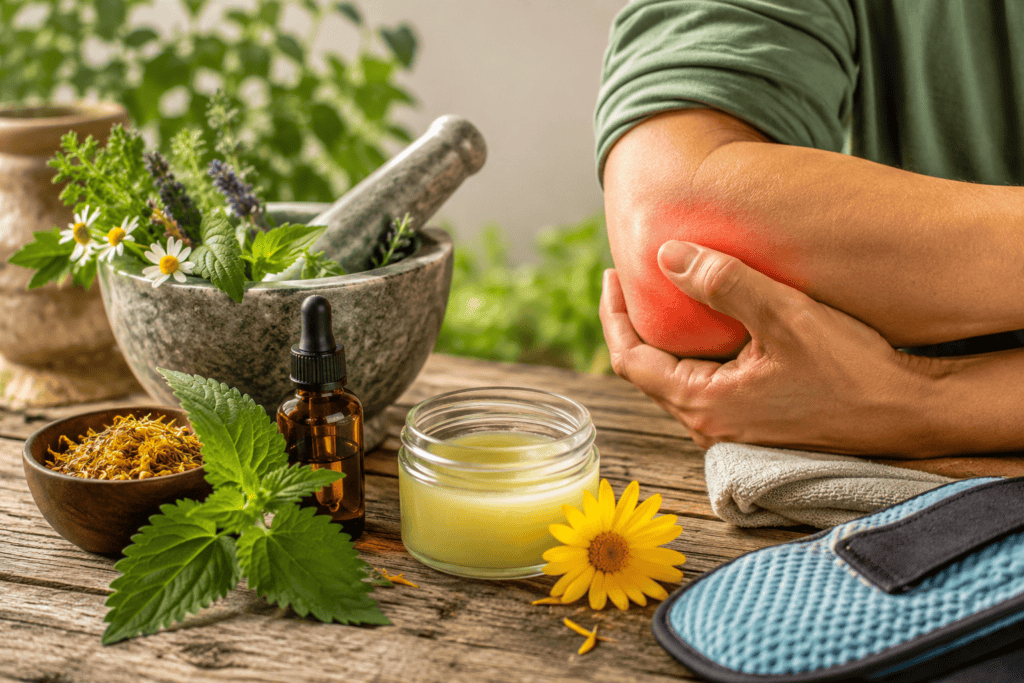
Tennis elbow — lateral epicondylitis — is one of the most common repetitive strain injuries affecting millions of people who have never picked up a tennis racket. Extended computer sessions, mouse use, repetitive gripping, and manual work can all trigger the same inflammation where the forearm extensor tendons attach to the outer elbow. I know this firsthand — after several long sessions building Root Freedom on the computer, my right elbow and forearm started giving me real trouble. The burning, the weakness with certain grips, the constant urge to move it around for relief. That’s when I reached for what was growing right outside — and discovered again just how powerful our South Texas native plants can be.
Quick Answer
The most effective natural remedies for tennis elbow include capsaicin for topical substance P depletion, turmeric for tendon inflammation, arnica gel applied directly to the outer elbow, magnesium for muscle tension and tissue healing, and targeted stretching of the forearm extensors. Addressing both the inflammation and the mechanical tension that caused it produces the fastest and most lasting relief.
What You’ll Learn
- What causes tennis elbow and why it is so slow to heal
- The seven best herbs and natural remedies for tennis elbow pain and healing
- The most effective stretches for tennis elbow relief
- Ergonomic and lifestyle changes that prevent recurrence
- When tennis elbow requires medical evaluation
Understanding Tennis Elbow
Tennis elbow develops when repetitive stress causes micro-tears in the extensor carpi radialis brevis tendon — the primary tendon attaching the forearm extensor muscles to the lateral epicondyle of the elbow. This triggers an inflammatory response that over time can become a chronic degenerative condition.
Common causes:
- Extended computer and mouse use — particularly with the elbow resting on a hard surface
- Repetitive gripping and wrist extension — tools, gardening, manual work
- Racket sports — tennis, squash, badminton
- Painting, plumbing, and other trades
- Keyboard and mouse use with poor ergonomics
Typical symptoms:
- Pain and burning on the outer elbow
- Weakness with certain grips — handshakes, lifting, turning a doorknob
- Pain radiating down the forearm
- Constant urge to move or reposition the elbow
- Stiffness in the morning that loosens with movement
- Worsening with prolonged computer use or gripping activities
Why tennis elbow heals slowly:
Tendons have poor blood supply compared to muscle — healing is inherently slow. The forearm extensors are used in almost every hand and wrist movement making complete rest nearly impossible. Most people experience a frustrating cycle of improvement and relapse without addressing the root cause.
Important Note Before We Begin
Tennis elbow with significant weakness, numbness or tingling into the hand and fingers, or pain that is rapidly worsening should be evaluated by a healthcare provider to rule out nerve compression, cubital tunnel syndrome, or other conditions. Persistent tennis elbow not responding to conservative treatment after 6-8 weeks warrants medical evaluation.
The Best Natural Remedies for Tennis Elbow
1. Capsaicin — Substance P Depletion for Nerve Pain
Capsaicin from chilli peppers depletes substance P — the neurotransmitter responsible for transmitting pain signals along nerve pathways — making it one of the most effective topical remedies for the chronic nerve pain component of tennis elbow.
On our South Texas farm we have wild Chilli Pequin growing — the same fiery native pepper we wrote about in our Chilli Pequin Benefits post. When my elbow started giving me real trouble I crushed a fresh Chilli Pequin berry and rubbed it directly on the outer elbow. The relief was almost immediate — that intense warming sensation followed by genuine pain reduction. That is capsaicin’s substance P mechanism at work in its most natural form.
Best for: Chronic outer elbow pain, nerve-component pain, burning and radiating forearm pain, ongoing daily pain management
What research shows: Multiple clinical trials confirm topical capsaicin significantly reduces chronic musculoskeletal and nerve pain through substance P depletion. It is FDA approved as a topical analgesic. Relief builds with consistent application as substance P stores deplete over the first 1-2 weeks.
How to use it: Apply diluted capsaicin cream to the outer elbow and upper forearm 3-4 times daily. The initial burning sensation is normal and diminishes with consistent use — relief increases over time. Never apply to broken skin. Wash hands thoroughly after application. For the farm-authentic approach crush a fresh Chilli Pequin berry and apply directly — same mechanism, zero cost if it’s growing on your property.
Where to get it: Capsaicin cream on Amazon. For the full story on capsaicin from our South Texas farm see our post on Chilli Pequin Benefits.
2. Turmeric — Tendon Inflammation Support
Turmeric’s curcumin addresses the inflammatory component of tennis elbow through the same COX-2 and NF-kB pathways targeted by NSAIDs — without the gastrointestinal risks of long-term NSAID use. It also supports collagen synthesis essential for tendon repair.
Best for: Chronic tendon inflammation, daily anti-inflammatory support, tennis elbow alongside other inflammatory conditions, supporting tissue repair
What research shows: Multiple studies confirm curcumin reduces musculoskeletal inflammation comparably to NSAIDs for some conditions. Research also shows curcumin supports collagen synthesis — particularly relevant for the degenerative component of chronic tennis elbow where tendon repair is as important as inflammation reduction.
How to use it: Turmeric with black pepper capsules — 500-1000mg of turmeric extract with piperine twice daily with food containing healthy fat. Black pepper increases curcumin absorption by 2000% and is essential for therapeutic effect. Golden milk with black pepper and coconut milk daily provides a food-based anti-inflammatory foundation.
Where to get it: Organic turmeric root powder from Starwest Botanicals turmeric root powder. Turmeric with piperine capsules on Amazon.
3. Arnica — Topical Pain and Inflammation
Arnica is one of the most evidence-supported topical herbs for musculoskeletal pain and inflammation. Its helenalin content reduces inflammatory mediators and provides direct analgesic effects at the application site — making it particularly useful for the localized outer elbow pain of tennis elbow.
Best for: Acute tennis elbow flares with significant inflammation, post-activity elbow pain, topical pain relief, tenderness on direct palpation of the lateral epicondyle
What research shows: Multiple clinical trials confirm topical arnica gel reduces musculoskeletal pain and inflammation. A study comparing arnica gel to ibuprofen gel found comparable effectiveness. Its direct anti-inflammatory and analgesic effects at the application site make it highly relevant for tennis elbow.
How to use it: Apply arnica gel to the outer elbow and upper forearm 3-4 times daily. Massage gently into the tissue for improved penetration. Alternate with capsaicin — apply arnica in the morning and midday, capsaicin in the evening — for complementary mechanisms throughout the day.
Important: Never apply arnica to broken skin. Do not take arnica internally.
Where to get it: Arnica gel on Amazon — look for standardized preparations with 10-25% arnica extract.
4. Magnesium — Tissue Healing and Muscle Relaxation
Magnesium deficiency contributes to tennis elbow through multiple mechanisms — it increases muscle tension in the forearm muscles that stress the lateral epicondyle attachment, impairs collagen synthesis needed for tendon repair, and worsens the inflammatory response.
Best for: Tennis elbow with significant forearm muscle tightness, slow healing cases, nighttime cramping alongside elbow pain, stress-worsened tennis elbow
What research shows: Magnesium’s essential role in collagen synthesis makes it particularly relevant for connective tissue injuries like tennis elbow. Research consistently shows magnesium reduces muscle tension and improves tissue healing. Topical magnesium applied directly to tense forearm muscles reduces the mechanical tension driving lateral epicondyle stress.
How to use it: Magnesium glycinate 200-400mg in the evening with dinner for systemic support. Topically — spray magnesium oil directly on the forearm and outer elbow morning and evening. Massage into the forearm muscles for 3-5 minutes working from wrist toward elbow.
Where to get it: Magnesium glycinate capsules on Amazon. Topical magnesium oil on Amazon.
5. Devil’s Claw — Chronic Pain Relief
Devil’s claw has the strongest clinical evidence of any herb specifically for musculoskeletal pain. Its harpagoside content inhibits COX-2 and TNF-alpha — the inflammatory mediators driving chronic tennis elbow pain — making it particularly valuable for cases that have become chronic.
Best for: Chronic tennis elbow lasting more than 3 months, daily pain management, reducing dependence on NSAIDs, tennis elbow with accompanying neck or shoulder pain
What research shows: Multiple randomized controlled trials confirm devil’s claw significantly reduces musculoskeletal pain. Its specific mechanism on COX-2 and TNF-alpha makes it highly relevant for chronic lateral epicondylitis.
How to use it: Devil’s claw capsules — 600-800mg of standardized extract once or twice daily with food. Give it 2-4 weeks of consistent daily use for full anti-inflammatory benefit. Works best as a sustained protocol rather than taken only during acute flares.
Where to get it: Devil’s claw capsules on Amazon. Dried devil’s claw root from Starwest Botanicals Dried devil’s claw root.
6. Ginger — Anti-Inflammatory and Circulatory Support
Ginger’s gingerols inhibit prostaglandin synthesis — a key inflammatory pathway in tendon pain — while improving local circulation to the poorly vascularized tendon tissue. Applied as a warm compress it delivers both therapeutic warmth and anti-inflammatory compounds directly to the elbow.
Best for: Acute tennis elbow flares, improving circulation to the tendon for faster healing, anti-inflammatory support alongside turmeric, warming elbow compress
How to use it: Internally — brew fresh ginger tea 2-3 cups daily. Topically — ginger compress: simmer 6-8 slices of fresh ginger in 4 cups water for 20 minutes, soak a cloth in the liquid and apply to the outer elbow for 15-20 minutes. The warmth improves circulation to the tendon while gingerols reduce local inflammation.
Where to get it: Fresh ginger from any grocery store. Dried ginger root from Starwest Botanicals Dried Ginger root.
7. Boswellia — Connective Tissue Inflammation
Boswellia’s boswellic acids inhibit 5-LOX — a leukotriene inflammatory pathway particularly relevant to connective tissue conditions like tennis elbow. Combined with turmeric it provides more complete anti-inflammatory coverage than either alone.
Best for: Chronic tennis elbow with connective tissue involvement, cases not responding well to turmeric alone, tennis elbow alongside other connective tissue conditions
What research shows: Clinical trials confirm boswellia reduces pain and improves function in musculoskeletal conditions. Its 5-LOX inhibition addresses inflammatory pathways not targeted by COX inhibitors — making it complementary to turmeric.
How to use it: Boswellia extract capsules — 300-500mg standardized extract twice daily with food. Combine with turmeric for synergistic anti-inflammatory coverage across both COX and LOX pathways.
Where to get it: Boswellia extract capsules on Amazon — look for standardized to 65% boswellic acids.
The Most Effective Tennis Elbow Stretches
Mechanical tension in the forearm extensors is the primary driver of lateral epicondyle stress. These three stretches address the root mechanical cause.
Wrist Extensor Stretch — The Most Important Exercise
How to do it: Straighten your affected arm fully in front of you with palm facing down. Use your other hand to gently bend your wrist downward until you feel a stretch along the top of the forearm and outer elbow. Hold 30 seconds. Repeat 3 times. Perform before computer sessions and after any activity that aggravates the elbow. This is the single most important exercise for tennis elbow.
Wrist Flexor Stretch — Complementary Balance
How to do it: Straighten your arm with palm facing up. Gently bend the wrist back toward you until you feel a stretch along the inner forearm. Hold 30 seconds. Repeat 3 times. Balances the forearm musculature and reduces overall tension on the elbow.
Towel Twist — Eccentric Strengthening
How to do it: Hold a rolled towel with both hands. Twist it in opposite directions like wringing out water — slowly and with controlled resistance. Repeat 10 times in each direction. Eccentric loading of the extensor tendons stimulates healing and builds tendon resilience over time. Start gently and increase resistance gradually.
Your Tennis Elbow Recovery Protocol
Daily Management Protocol
| Time | Herb or Action | Purpose |
|---|---|---|
| Morning | Wrist extensor stretch 3 repetitions | Tendon decompression |
| Morning | Turmeric with black pepper capsule | Systemic inflammation |
| Morning | Arnica gel on outer elbow | Topical pain and inflammation |
| Morning | Magnesium oil on forearm | Muscle tension reduction |
| Midday | Arnica gel reapplication | Ongoing topical support |
| Midday | Ginger tea | Anti-inflammatory support |
| After computer use | Ice pack 15 minutes on outer elbow | Acute inflammation management |
| Evening | Ginger compress on elbow 15 minutes | Circulation and anti-inflammatory |
| Evening | Capsaicin cream on outer elbow | Substance P depletion |
| Evening | Magnesium glycinate capsule | Tissue healing and relaxation |
| Before bed | Wrist extensor stretch 3 repetitions | Overnight tension reduction |
Ergonomic Changes That Make the Biggest Difference
Stop resting your elbow on hard surfaces — this is the single most important ergonomic change for computer-related tennis elbow. The hard edge of a desk or armrest compresses the ulnar nerve and increases lateral epicondyle stress with every hour of use. Resting on a soft surface — a folded towel, a soft armrest, or your knee as I discovered — immediately reduces this pressure.
Mouse position — keep the mouse close to the body to reduce elbow extension. A vertical mouse reduces forearm rotation that stresses the lateral epicondyle. A mouse pad with a wrist rest reduces forearm extensor tension.
Take breaks every 30 minutes — stand, fully straighten the arm, perform the wrist extensor stretch. This prevents the sustained muscle contraction that accumulates into tendon stress over long sessions.
Keyboard height — elbows should be at roughly 90 degrees when typing. A keyboard that is too high causes sustained forearm extensor activation that directly stresses the lateral epicondyle.
When to See a Doctor
See a healthcare provider if tennis elbow does not show meaningful improvement after 6-8 weeks of consistent conservative treatment. Seek evaluation for numbness or tingling into the ring and pinky fingers — this suggests cubital tunnel syndrome rather than pure tennis elbow and requires different treatment. See a doctor if weakness is rapidly progressing or if pain is severe enough to prevent normal daily activities. Conventional treatment options including physical therapy, cortisone injection, platelet-rich plasma therapy, and in rare cases surgery are available for persistent tennis elbow. The Herbal Academy offers excellent resources on anti-inflammatory herbs and building a complete natural pain management protocol.
Key Takeaways
- Tennis elbow is driven by micro-tears and inflammation in the extensor tendon — addressing both inflammation and mechanical tension produces the best results
- Capsaicin from Chilli Pequin or commercial cream depletes substance P providing pain relief that builds with consistent topical application — the farm-authentic discovery that started this journey
- The wrist extensor stretch performed consistently is the single most important exercise for tennis elbow recovery
- Stop resting your elbow on hard surfaces — this is the most impactful ergonomic change for computer-related tennis elbow
- Turmeric and boswellia together cover both COX and LOX inflammatory pathways for more complete anti-inflammatory coverage
- Tendons heal slowly due to poor blood supply — consistent daily treatment over weeks produces gradual but meaningful improvement
- Seek medical evaluation if numbness or tingling develops in the fingers — this suggests nerve involvement requiring specific assessment
At a Glance
| Remedy | Type | Primary Action |
|---|---|---|
| Capsaicin | Topical | Substance P depletion |
| Turmeric | Internal | COX-2 inflammation reduction |
| Arnica | Topical | Direct pain and inflammation |
| Magnesium | Internal and topical | Tissue healing and muscle relaxation |
| Devil’s claw | Internal | Chronic musculoskeletal pain |
| Ginger | Internal and compress | Anti-inflammatory and circulation |
| Boswellia | Internal | 5-LOX connective tissue inflammation |
| Wrist extensor stretch | Exercise | Root mechanical tension reduction |
Frequently Asked Questions
What is the fastest natural remedy for tennis elbow pain?
Applying arnica gel and capsaicin cream to the outer elbow combined with an ice pack for 15 minutes provides the fastest multi-mechanism relief for acute tennis elbow pain. The wrist extensor stretch immediately reduces mechanical tension on the inflamed tendon attachment.
How long does tennis elbow take to heal naturally?
Tennis elbow typically takes 6-18 months to fully resolve even with consistent treatment. Most people experience meaningful improvement within 4-8 weeks of consistent stretching, ergonomic correction, and anti-inflammatory herb use. Addressing the root mechanical cause — particularly stopping elbow resting on hard surfaces — dramatically accelerates recovery.
Is heat or ice better for tennis elbow?
Both have a role depending on timing. Ice for 15 minutes immediately after activity or during acute flares reduces inflammation. Heat — particularly a ginger compress — before activity improves circulation and flexibility in the tendon. Contrast therapy alternating both accelerates healing.
Can tennis elbow heal without rest?
Complete rest is rarely practical or necessary. Relative rest — reducing the specific activities that aggravate it while maintaining gentle movement — produces better outcomes than strict immobilization. The towel twist eccentric exercise actually loads the tendon in a controlled way that stimulates healing.
What makes tennis elbow worse?
The most common aggravators are resting the elbow on hard surfaces, gripping activities with the wrist extended, lifting with the palm facing down, and prolonged computer use without breaks. Identifying and modifying your specific aggravators is as important as any herbal remedy.
Does capsaicin really work for elbow pain?
Yes — both clinical research and personal experience confirm it. The substance P depletion mechanism is well documented for chronic musculoskeletal and nerve pain. The initial burning sensation on application is normal and diminishes with consistent use as substance P stores deplete. Relief builds over the first 1-2 weeks of consistent application.
Related Posts You’ll Love
- Chilli Pequin Benefits — The Wild Texas Pepper — the South Texas native capsaicin source that started this elbow remedy discovery
- Natural Remedies for Sciatica — nerve and connective tissue pain sharing many herbal remedies with tennis elbow
- Natural Remedies for Joint Pain and Inflammation — broader joint and connective tissue support
- Natural Remedies for Plantar Fasciitis — another connective tissue condition responding to similar herbal approaches
- How to Harvest and Preserve Wild Chilli Pequin — how to harvest the capsaicin source growing wild on our South Texas farm
Not sure which herbs are right for your specific situation? Take our free Natural Wellness Assessment and get a personalized herbal remedy report delivered straight to your inbox.
Get Your Free Natural Home Remedies Quick Reference Card
12 common ailments, the herb that helps, and exactly how to use it — free instant download.
This post contains affiliate links. Root Freedom may earn a commission when you purchase through our links at no extra cost to you. This content is for informational purposes only and is not intended as medical advice. Always consult a healthcare professional before beginning any new herbal regimen.