
Written by Chad & Millie of Root Freedom
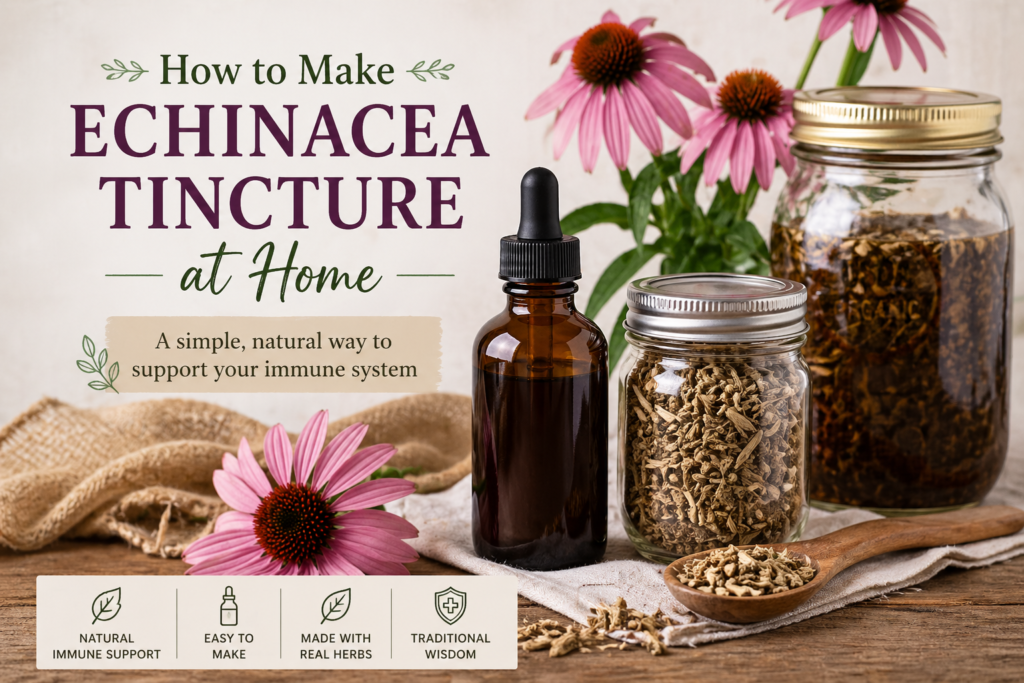
Echinacea tincture is one of the most powerful immune-boosting remedies you can make at home. Unlike teas that require daily brewing, a tincture takes minutes to make, lasts for years, and delivers a concentrated dose of echinacea’s active compounds directly into your bloodstream.
Let’s explore How to Make Echinacea Tincture at Home. Once you make your first tincture you’ll wonder why you ever bought the expensive store versions.
Quick Answer — How Do You Make Echinacea Tincture at Home?
Fill a clean mason jar halfway with dried echinacea root or aerial parts. Cover completely with 80 proof vodka until alcohol sits 1-2 inches above the plant material. Seal tightly and store in a cool dark place for 4-6 weeks, shaking daily. Strain through cheesecloth, bottle in dark glass dropper bottles, and label with date. Take 30 drops in water at first sign of illness every 3-4 hours. Homemade tincture costs $8-12 for 8-12oz versus $15-25 for 1oz store bought — 8-12 times the volume for the same cost.
What You’ll Learn
- What a tincture is and why it’s more potent than echinacea tea or capsules
- Exactly which echinacea species and plant parts to use and why it matters
- Step by step instructions for making your first echinacea tincture at home
- How to dose correctly — prevention vs active illness protocols
- The alcohol-free glycerite alternative for children and alcohol-sensitive users
- How to grow your own echinacea for a sustainable long term supply
- Cost comparison — homemade vs store bought
What Is a Tincture?
A tincture is an herbal extract made by soaking plant material in alcohol. The alcohol pulls out the medicinal compounds — alkaloids, flavonoids, polysaccharides — and preserves them in concentrated liquid form.
Echinacea tincture is taken as drops under the tongue or in water. It absorbs faster than capsules or teas and is significantly more potent per dose.
Why Echinacea?
Echinacea is one of the most studied medicinal herbs in the world. Research consistently shows it can reduce the duration of colds by up to 4 days, reduce the severity of cold and flu symptoms, stimulate white blood cell production, and reduce the likelihood of catching a cold when taken preventatively.
It works best taken at the very first sign of illness — not after you’re already deep into a cold.
What You’ll Need
Ingredients:
- 1 cup dried echinacea root or aerial parts
- 2 cups 80 proof vodka or grain alcohol
Equipment:
- Glass mason jar with tight lid
- Fine mesh strainer or cheesecloth
- Dark glass dropper bottles for storage
- Labels
Where to get dried echinacea: High quality dried echinacea root from Starwest Botanicals dried echinacea root. Or grow your own purple coneflower from seed with Seeds_Now — it’s a beautiful perennial that comes back stronger every year.
Step-by-Step Instructions
Step 1 — Prepare your jar
Make sure your mason jar is completely clean and dry. Any water in the jar can dilute your alcohol ratio and affect preservation.
Step 2 — Add the echinacea
Place your dried echinacea root or aerial parts into the mason jar. Fill the jar roughly halfway with herb material — don’t pack it too tightly.
Step 3 — Cover with alcohol
Pour your vodka over the echinacea until the herb is completely submerged and the alcohol sits at least 1-2 inches above the plant material. Echinacea will absorb some liquid as it sits so check after 24 hours and top up if needed.
Step 4 — Seal and store
Seal the jar tightly and store in a cool dark place — a cupboard or pantry works perfectly. Shake the jar once daily for 4-6 weeks.
Step 5 — Strain
After 4-6 weeks strain the liquid through cheesecloth or a fine mesh strainer into a clean bowl. Squeeze the herb material firmly to extract every last drop of tincture.
Step 6 — Bottle and label
Pour your finished tincture into dark glass dropper bottles — amber or cobalt blue glass protects the tincture from light degradation. Label with the herb name, alcohol used, and date made.
Stored properly in a cool dark place your echinacea tincture will last 3-5 years.
How to Use Your Echinacea Tincture
For immune prevention during cold and flu season: 30 drops in a small glass of water or juice, twice daily.
At the first sign of illness: 30-40 drops in water every 3-4 hours for the first 24-48 hours. Then reduce to 3 times daily for up to 10 days.
Important: Take echinacea in cycles — 10 days on, 3 days off. Long-term continuous use reduces effectiveness. It’s a powerful immune activator, not a daily maintenance herb.
Taste note: Echinacea tincture has a distinctive tingly, slightly numbing sensation on the tongue. This is completely normal — it’s actually a sign of quality and potency.
Which Part of the Echinacea Plant to Use
Echinacea has three commonly used species and multiple plant parts — root, leaves, flowers, and seeds. Here’s what you need to know:
Echinacea purpurea aerial parts — leaves, flowers, seeds harvested during flowering. High in polysaccharides that stimulate immune activity. Most commonly used for tinctures.
Echinacea angustifolia root — considered the most potent species for immune support. Slower growing but highly medicinal.
Our recommendation: Use Echinacea purpurea aerial parts for your first tincture — easier to source and fast-acting.
Non-Alcohol Alternative — Glycerite
If you prefer an alcohol-free tincture substitute vegetable glycerin for the vodka. Use the same process with the same ratios.
Glycerites are sweeter, gentler, and suitable for children over 2 years old. They have a shorter shelf life — 1-2 years versus 3-5 years for alcohol tinctures — and are slightly less potent but still effective.
Grow Your Own Echinacea
Echinacea purpurea is one of the most rewarding medicinal plants you can grow. It’s a hardy perennial that returns every year, gets more productive with age, and produces stunning purple flowers that attract pollinators all summer.
Plant in full sun, well-drained soil. Harvest aerial parts — leaves and flowers — during peak bloom for highest potency. Harvest roots in fall of the third year when they’re fully mature.
Get echinacea seeds from Seeds_Now and start your own medicinal patch this season.
Cost Comparison
Store-bought echinacea tincture: $15-25 for 1oz — lasts about 2-3 weeks of active use
Homemade echinacea tincture: $8-12 in ingredients for 8-12oz — lasts months to years
You get 8-12 times the volume for the same cost. And you control every ingredient.
Key Takeaways
- Echinacea tincture works best taken at the very first sign of illness — not after symptoms are fully developed. The 30-40 drops every 3-4 hours protocol in the first 24 hours is your most powerful window
- Use 80 proof vodka — not higher proof spirits. The water content in 80 proof alcohol is necessary for extracting the water-soluble polysaccharides that give echinacea its immune-stimulating activity
- Take echinacea in cycles — 10 days on, 3 days off. Continuous use reduces effectiveness as the immune system adapts
- The tingly numbing sensation on your tongue when taking echinacea tincture is a sign of quality and potency — it indicates the alkylamides are present and active
- Echinacea purpurea aerial parts are the easiest to source and fastest acting for beginners. Echinacea angustifolia root is more potent but slower growing
- Properly stored in dark glass away from heat and light your homemade echinacea tincture lasts 3-5 years — making it one of the most cost effective herbal preparations you can make
Frequently Asked Questions
Can I use fresh echinacea instead of dried? Yes — fresh echinacea actually makes an excellent tincture. Use a higher ratio of plant material since fresh herbs contain more water. Pack the jar tightly with fresh aerial parts and cover with 80-100 proof vodka. The higher alcohol content compensates for the moisture in the fresh plant material. Dried is more practical for most home herbalists since it’s available year round.
How do I know when my tincture is ready? After 4-6 weeks the liquid should be dark golden to amber brown with a strong distinctive echinacea smell. Taste a drop — you should feel the characteristic tingly numbing sensation on your tongue. If the tingle is strong and the color is deep your tincture is ready.
Can children take echinacea tincture? Children over 2 years can take echinacea but the alcohol-based tincture is not appropriate for young children. Make a glycerite instead using vegetable glycerin instead of vodka — same process, alcohol free, slightly sweeter taste, shorter shelf life of 1-2 years. Always consult your pediatrician before giving any herbal preparation to children.
How long does homemade echinacea tincture last? Properly made and stored echinacea tincture lasts 3-5 years. Store in dark glass dropper bottles away from heat, light, and moisture. Amber or cobalt blue glass protects the active compounds from light degradation. Label with the date made so you can track freshness.
Can I use echinacea tincture every day as a preventive? Short term preventive use during cold and flu season is appropriate — 30 drops twice daily for up to 10 days at a time, then take a 3 day break before resuming. Long term continuous daily use is not recommended as it reduces effectiveness over time. Think of echinacea as an immune activator to use strategically rather than a daily maintenance supplement.
What is the difference between echinacea root and aerial parts for tincture? Echinacea root — especially angustifolia root — contains higher concentrations of alkylamides which are responsible for the tingly sensation and direct immune activity. Aerial parts — leaves, flowers, seeds — are higher in polysaccharides that stimulate white blood cell production. Both are effective. For your first tincture use purpurea aerial parts — easier to source, fast acting, and well studied. Advanced herbalists often combine both for a full spectrum preparation.
More Tinctures to Try Next
Once you’ve mastered echinacea tincture the process applies to virtually any medicinal herb. Try these next:
- Valerian root tincture for sleep
- Lemon balm tincture for anxiety
- Elderberry tincture for immune support
Check out our Elderberry Syrup recipe and 10 Herbs Every Natural Wellness Cabinet Needs for more home remedy inspiration.
The Herbal Academy Online Herbalism Courses — take your herbal knowledge further with beginner through advanced online courses taught by certified herbalists
Related Posts You’ll Love
- Best Herbs for Immune Support — build your complete natural immune defense beyond echinacea
- Natural Remedies for Cold and Flu Season — echinacea tincture is your most powerful tool in this protocol
- How to Make Elderberry Syrup at Home — combine with echinacea tincture for maximum immune protection
- Oil of Oregano Benefits — Nature’s Most Powerful Antimicrobial Herb — another powerful natural antimicrobial for your home remedy kit
- Natural Longevity Supplements and Herbs — Evidence Based Guide to Healthy Aging — herbs and supplements that target the biological mechanisms of aging
- Herbal Academy Review — Is It Worth It? — learn to make tinctures and more with structured herbal education
Looking to build a natural home remedy cabinet and not sure where to start? Take our free Natural Wellness Assessment and get a personalized herbal remedy report delivered straight to your inbox.
Get Your Free Natural Home Remedies Quick Reference Card
12 common ailments, the herb that helps, and exactly how to use it — free instant download.
This post contains affiliate links. Root Freedom may earn a commission when you purchase through our links at no extra cost to you. This content is for informational purposes only and is not intended as medical advice. Always consult a healthcare professional before beginning any new herbal regimen.