Written by Chad & Millie of Root Freedom
We started making our own toothpaste for the same reason we do most things around here — we wanted to actually know what’s going into it. What started as an experiment has become our regular routine, and this natural homemade toothpaste recipe is the version we’ve landed on after a few rounds of adjusting it.
Quick Answer
Our natural homemade toothpaste recipe combines coconut oil, beeswax, baking soda, and xylitol as the core base, with peppermint or clove essential oil for flavor and a mild antibacterial boost. Xylitol is the ingredient doing the most real work here — it’s genuinely well-documented to reduce cavity-causing bacteria over time, not just sweeten the mix. This isn’t a fluoride-free miracle cure, and we say that honestly upfront — it’s a natural alternative we’ve chosen for our own family, not a guaranteed replacement for standard dental care.
What You’ll Learn
- Exactly what goes into our homemade toothpaste and why
- What real research says about each ingredient, including where the evidence is strong and where it’s thinner
- Step-by-step instructions to make your own batch, adjusted for hot climates
- The honest fluoride conversation most natural recipes skip
- A note on bentonite clay, if you’re considering adding it for texture
- When homemade toothpaste isn’t the right call
Understanding Natural Toothpaste
Most commercial toothpaste relies on fluoride, foaming agents like sodium lauryl sulfate, artificial sweeteners, and preservatives to do its job. Natural toothpaste recipes swap those out for ingredients that clean, mildly whiten, and support a healthy mouth environment through different mechanisms — abrasion, mineral content, and antibacterial action rather than a single active pharmaceutical ingredient.
The tradeoff is real, and we want to be upfront about it rather than gloss over it the way a lot of natural recipes do: fluoride has decades of strong clinical evidence behind it specifically for cavity prevention, and dental associations broadly recommend it. Natural alternatives like xylitol have real, growing research behind them too, but it’s a different evidence base, and going fluoride-free is a genuine personal choice with tradeoffs, not an obviously superior swap for everyone.
Important Note Before We Begin
This recipe is what our family personally uses, not a universal recommendation. If you have a history of cavities, active dental issues, or are unsure about going fluoride-free, talk to your dentist first — this isn’t something to switch to blindly, especially for kids.
Our Homemade Toothpaste Recipe
Ingredients
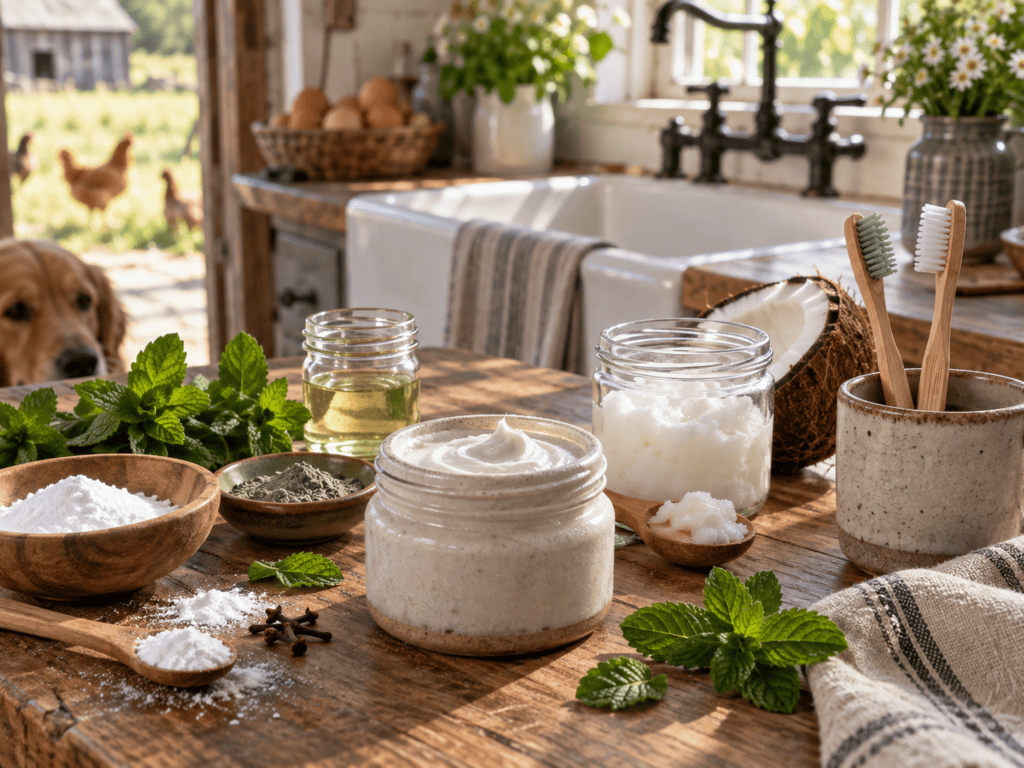
- 3 tablespoons coconut oil (unrefined, extra-virgin)
- 1-2 tablespoons baking soda
- 1-2 tablespoons xylitol powder (finely ground)
- 10-15 drops peppermint or clove essential oil
- ¼ teaspoon fine sea salt (optional)
- 1 tablespoon beeswax pellets (if you’re in a warmer climate like ours here in South Texas — see note below)
Instructions
- Melt the coconut oil and beeswax together — a double boiler or a heatproof jar set in a bowl of hot water both work — stirring until the beeswax fully dissolves into the oil.
- In a glass or plastic bowl, combine the baking soda, xylitol, and sea salt.
- Pour in the melted coconut oil and beeswax, stirring until you get a smooth, thick paste.
- Add your essential oil a few drops at a time, tasting as you go, until it’s flavored to your liking.
- Transfer to a small glass jar with a lid while still soft — it firms up as it cools. Use a clean spoon or small spatula to apply to your toothbrush rather than dipping the brush directly in, which extends shelf life.
Yield: about 2 oz, lasting roughly 1-1.5 months with regular use.
A note from our farm: if you’re somewhere hot — South Texas summers included — plain coconut oil melts around 76°F, which is basically room temperature here most of the year. We learned this the hard way: the toothpaste turns to soup on the counter, and putting it in the fridge to fix that just makes it too hard to scoop. Adding the tablespoon of beeswax above fixes both problems at once, since beeswax doesn’t melt until around 145°F — it holds a stable texture no matter how hot your bathroom gets.
Why Each Ingredient Is In There
1. Xylitol — The Real Workhorse
Best for: Reducing cavity-causing bacteria over time
What research shows: Xylitol has real, meaningful research behind it specifically for dental health — it’s been shown to reduce plaque and harmful bacteria in the mouth, and with consistent use over time, can help reduce the population of decay-causing bacteria. This is genuinely the strongest evidence-backed ingredient in this whole recipe.
How to use it: Grind into a fine powder before mixing in — this makes it blend smoothly rather than sitting gritty in the final paste.
Where to get it: Xylitol powder on Amazon.
2. Coconut Oil — The Base
Best for: A smooth base with real antibacterial properties of its own
What research shows: Coconut oil has documented antibacterial activity against some of the bacteria strains linked to tooth decay and gum disease, and it’s also the traditional base for oil pulling, a separate but related oral care practice.
How to use it: Use unrefined, extra-virgin coconut oil for the cleanest flavor and highest quality.
Where to get it: Organic extra virgin coconut oil on Amazon.
3. Beeswax — Keeping It From Melting in the Texas Heat (Optional)
Best for: Stabilizing the texture so it doesn’t liquify or harden
What research shows: Beeswax melts around 145°F, far higher than coconut oil’s 76°F, and it’s a long-standing natural thickener in salves and balms for exactly this reason — it raises the working temperature range of anything it’s blended into.
How to use it: Melt it together with the coconut oil first, before adding any dry ingredients.
Where to get it: Beeswax pellets on Amazon.
4. Baking Soda — Gentle Whitening
Best for: Mild abrasive cleaning and whitening
What research shows: Baking soda genuinely helps clean teeth and neutralize the acids in the mouth that contribute to decay, and it’s one of the more well-established natural whitening ingredients — but too much can be abrasive to enamel and irritating to gums over time, which is exactly why it’s balanced with other ingredients here rather than used alone.
How to use it: A little goes a long way — this recipe intentionally uses less baking soda than some other homemade versions to avoid overdoing the abrasiveness.
Where to get it: Baking soda, widely available at any grocery store.
5. Peppermint or Clove Essential Oil — Flavor and a Little More
Best for: Flavor, breath freshness, and a traditional dental use for clove specifically
What research shows: Peppermint provides flavor and a cooling, fresh sensation. Clove has real traditional history in dental care specifically — it’s long been used for tooth pain relief, and carries genuine antibacterial properties.
How to use it: Start with fewer drops than you think you need and add gradually — these oils are potent, and a light dilution (around 10-15 drops per this batch size) is plenty.
Where to get it: Cliganic Peppermint Essential Oil — USDA certified organic and Clove essential oil.
A Note on Bentonite Clay, If You’re Considering It
Some natural toothpaste recipes add bentonite clay for texture and mineral content, and you may see it recommended elsewhere. We chose to leave it out of our own recipe: independent lab testing and a past FDA consumer warning have both identified bentonite clay as the most common source of heavy metal (lead) contamination among natural toothpaste ingredients, more than other common additives. This is tied to how and where the clay is mined, and non-fluoride toothpaste is regulated by the FDA as a cosmetic, with far less heavy-metal testing oversight than fluoride toothpaste — meaning contamination can go undetected unless a company voluntarily tests for it.
If you still want to add it for texture, do your own research first and only use a bentonite clay from a supplier that publishes actual third-party heavy-metal lab test results for that specific batch — a “food-grade” label alone isn’t the same as verified clean. Mix and store it in glass or plastic only, never metal.
When to See a Dentist Instead
Homemade toothpaste is not a substitute for regular dental checkups, and it’s not the right call if you’re dealing with active cavities, gum disease, or significant dental sensitivity — see a dentist for those, not a DIY recipe. If you’re on the fence about going fluoride-free, that’s a genuinely personal decision worth discussing with your dentist rather than deciding purely from a blog post, ours included. If you want to go deeper into natural body care more broadly, Herbal Academy’s courses cover this kind of DIY formulation in real depth.
Key Takeaways
- Xylitol is the single most evidence-backed ingredient in natural toothpaste, genuinely shown to reduce cavity-causing bacteria over time
- Coconut oil and baking soda both have real documented benefits for oral bacteria and whitening, respectively
- Beeswax keeps the texture stable in hot climates, where plain coconut oil melts too easily
- Fluoride has strong, decades-long clinical evidence for cavity prevention that natural alternatives don’t fully match — this is a genuine tradeoff, not a clear upgrade
- If considering bentonite clay for texture, only use a supplier with published third-party heavy-metal test results — it’s a real, documented contamination risk, not just a preference
- This isn’t right for everyone — active dental issues need a dentist, not a DIY recipe
At a Glance
| Ingredient | Amount | Role |
|---|---|---|
| Coconut oil | 3 tbsp | Base, antibacterial |
| Beeswax | 1 tbsp | Holds texture, especially in heat |
| Baking soda | 1-2 tbsp | Gentle whitening/cleaning |
| Xylitol powder | 1-2 tbsp | Reduces cavity bacteria |
| Peppermint or clove EO | 10-15 drops | Flavor, mild antibacterial |
| Sea salt (optional) | ¼ tsp | Mild cleansing |
Frequently Asked Questions
Is homemade toothpaste as effective as store-bought?
It depends on what you’re comparing it to. This natural homemade toothpaste recipe has real, documented benefits from ingredients like xylitol and coconut oil, but it doesn’t have fluoride’s decades of clinical evidence specifically for cavity prevention. It’s a genuine personal choice, not a guaranteed upgrade.
Is bentonite clay safe in toothpaste?
We’d urge real caution here. Independent testing and a past FDA consumer warning have both linked bentonite clay to the highest heavy metal (lead) contamination levels among common natural toothpaste ingredients. If you choose to use it, only buy from a source with published third-party heavy-metal test results.
Is it safe for kids?
Talk to your dentist first, especially given the essential oil content and the fluoride question. Many families do use gentler versions with kids, but it’s worth a real conversation with your dentist rather than assuming.
How long does this toothpaste last?
About 1-1.5 months for a standard batch, stored in a sealed glass jar in a cool spot. Essential oils lose potency over time, so fresher batches smell and taste stronger.
Can I skip fluoride entirely and be fine?
That’s a personal decision to make with your dentist based on your own dental history and risk factors, not something we can answer for you. We made our choice for our own family — that doesn’t make it the right choice for everyone.
Related Posts You’ll Love
- How to Make a Healing Herbal Salve at Home — more DIY body care from scratch
- Natural Remedies for Tooth Pain and Oral Health — herbal support for oral discomfort specifically
- How to Make Herbal Bath Salts at Home — 8 Recipes — more natural self-care projects
- How to Make Herbal Infused Oil at Home — a foundational skill for DIY body care
- Best Herbs for Skin Health and Healing — more natural body care from the inside and out
Not sure which herbs are right for your specific situation? Take our free Natural Wellness Assessment and get a personalized herbal remedy report delivered straight to your inbox.
Get Your Free Natural Home Remedies Quick Reference Card
12 common ailments, the herb that helps, and exactly how to use it — free instant download.
This post contains affiliate links. Root Freedom may earn a commission when you purchase through our links at no extra cost to you. This content is for informational purposes only and is not intended as medical advice. Always consult a healthcare professional before beginning any new herbal regimen.