
Written by Chad & Millie of Root Freedom
Fire cider is one of the most potent natural immune tonics you can make at home. It’s a traditional folk remedy that has been used for generations to ward off colds, boost circulation, support digestion, and provide a powerful daily dose of nature’s most antimicrobial ingredients.
It’s also genuinely delicious once you acquire the taste — spicy, tangy, warming, and complex. A tablespoon a day keeps the doctor away more reliably than any apple ever did.
Best of all it costs a few dollars to make and lasts months in the refrigerator. Here is how to make fire cider at home for optimal immune support.
What Is Fire Cider?
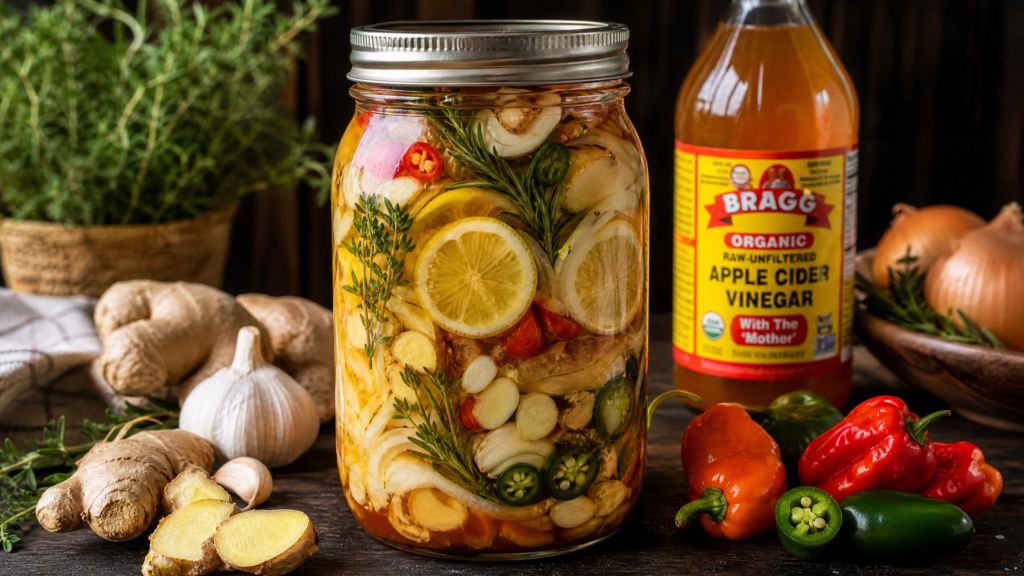
Fire cider is a traditional herbal oxymel — a preparation made by infusing herbs and other ingredients in apple cider vinegar and sweetening with honey. The acidic vinegar extracts water-soluble and some fat-soluble compounds from the ingredients while the honey adds antimicrobial properties and makes the final product palatable.
The traditional recipe varies by herbalist and region but always includes the core fire ingredients — horseradish, ginger, garlic, onion, and hot peppers — infused in raw apple cider vinegar with raw honey added at the end.
The Health Benefits of Fire Cider
Immune support — garlic’s allicin, horseradish’s glucosinolates, ginger’s gingerols, and cayenne’s capsaicin all have documented antimicrobial and immune-activating properties.
Circulation — cayenne and ginger are among the most powerful circulatory stimulants available. Fire cider warms the body from the inside out and improves peripheral circulation significantly.
Digestion — apple cider vinegar stimulates digestive enzyme and bile production. Ginger and horseradish both support healthy digestion and gut motility.
Antiviral and antibacterial — multiple ingredients in fire cider have broad-spectrum antimicrobial activity against common pathogens.
Anti-inflammatory — ginger, turmeric, and horseradish all reduce systemic inflammation through complementary pathways.
What You’ll Need
Core ingredients:
- ½ cup fresh horseradish root — grated
- ½ cup fresh ginger root — grated or thinly sliced
- 1 whole head of garlic — roughly chopped
- 1 medium onion — roughly chopped
- 2-3 hot peppers — jalapeño, habanero, or cayenne — sliced
- 2 cups raw apple cider vinegar — with the mother
- ¼ cup raw local honey — added after straining
Optional additions — highly recommended:
- 1 lemon — zest and juice
- 2 tablespoons fresh or dried turmeric root
- 1 tablespoon black peppercorns — increases turmeric absorption
- Fresh rosemary or thyme sprigs
- 1 cinnamon stick
- 1 tablespoon dried elderberries
- Orange zest
Equipment:
- Wide mouth quart mason jar
- Fine mesh strainer or cheesecloth
- Grater or food processor
- Glass bottle for storage
- Rubber or plastic lid — vinegar corrodes metal lids
Step-by-Step Instructions
Step 1 — Prepare your ingredients
Grate the horseradish root — this is the most pungent step. Work near an open window or outside if possible. Grate ginger root. Roughly chop garlic — don’t need to peel individual cloves. Roughly chop onion. Slice hot peppers.
Step 2 — Fill your jar
Pack all ingredients into a clean quart mason jar — fill it about ¾ full. Don’t worry about layering or exact amounts — fire cider is a forgiving recipe.
Step 3 — Cover with apple cider vinegar
Pour raw apple cider vinegar over the ingredients until everything is completely submerged and the jar is full. Stir with a clean spoon to release air bubbles.
Step 4 — Seal and store
Place a piece of parchment paper over the jar opening before putting the lid on — this prevents the vinegar from corroding the metal lid. Seal tightly.
Store in a cool dark place — a pantry or cupboard works perfectly. Shake the jar daily.
Step 5 — Infuse for 3-4 weeks
The minimum infusion time is 2 weeks but 3-4 weeks produces a significantly more complex and potent fire cider. The longer it infuses the more medicinal compounds are extracted.
Step 6 — Strain
After 3-4 weeks strain the fire cider through cheesecloth or a fine mesh strainer into a clean bowl. Squeeze or press the solid ingredients firmly to extract every drop of liquid.
Step 7 — Add honey
While the strained liquid is still at room temperature stir in ¼ cup of raw honey until completely dissolved. Taste and adjust — add more honey if you want it sweeter, more vinegar if you want more bite.
Step 8 — Bottle and store
Pour finished fire cider into glass bottles. Label with contents and date. Store in the refrigerator — it keeps for 6-12 months refrigerated.
How to Use Fire Cider
Daily prevention dose: 1 tablespoon straight or diluted in water daily. Take in the morning before breakfast for best absorption. Think of it as your daily immune insurance policy.
At first sign of illness: 1 tablespoon every 3-4 hours. The antimicrobial and immune-activating compounds work best taken frequently during acute illness rather than in larger single doses.
As a salad dressing base: Mix fire cider with olive oil for a spicy immune-boosting salad dressing. The heat mellows when combined with oil.
In warm drinks: Add 1-2 tablespoons to warm water with additional honey for a soothing hot tonic during illness.
As a cooking ingredient: Add to soups, stews, marinades, and sauces for flavor and immune benefits. Heat reduces some volatile compounds but the overall medicinal effect remains.
Shot style: Some people prefer taking it as a shot — chased with water or juice. The burn is intense but brief and many people find they come to enjoy it.
Variations to Try
Elderberry fire cider: Add ¼ cup dried elderberries to the infusion for additional antiviral support. The elderberries turn the fire cider a beautiful deep purple.
Four thieves fire cider: Add rosemary, sage, thyme, and lavender — the herbs from the legendary four thieves vinegar — for enhanced antimicrobial properties.
Digestive fire cider: Add fennel seeds, cardamom, and additional ginger. Focus on digestive support alongside immune benefits.
Citrus fire cider: Add the zest and juice of 2 lemons and 1 orange for vitamin C and bright citrus flavor that balances the heat.
The Fire Cider Herb Shopping List
Most fire cider ingredients are available fresh at grocery stores. For dried additions:
- Dried elderberries → Starwest Botanicals dried Elderberries
- Dried turmeric root → Starwest Botanicals Dried turmeric root
- Dried cayenne → Source it from your local produce store
- Dried rosemary and thyme → Starwest Botanicals Dried Rosemary, Starwest Botanicals Dried thyme
Grow your own horseradish, hot peppers, garlic, and herbs from seed with Seeds_Now.
Troubleshooting
Fire cider is too spicy: Use milder peppers next batch — jalapeño instead of habanero. Add more honey to finished product to balance heat.
Fire cider is too mild: Use more hot peppers and more horseradish. Infuse for longer.
Floating ingredients: Normal — shake daily to keep ingredients in contact with vinegar.
Cloudy appearance: Normal and desirable — indicates active compounds and the vinegar mother.
Mold: If you see mold the vinegar wasn’t enough to cover all ingredients. Discard and start over ensuring all ingredients are fully submerged.
Related Posts You’ll Love
- Best Herbs for Immune Support — fire cider ingredients in context with other immune herbs
- Natural Remedies for Cold and Flu Season — fire cider as part of your complete cold and flu protocol
- How to Make Elderberry Syrup at Home — another essential home immune preparation
- Best Herbs for Digestion and Bloating — fire cider supports digestion alongside immunity
- Herbal First Aid Kit — fire cider belongs in every herbal medicine chest
Get the Free Herbal Wellness Checklist
Click here to download your free Root Freedom Herbal Wellness Checklist →
Disclaimer: This post contains affiliate links. Root Freedom may earn a commission when you purchase through our links at no extra cost to you. This content is for informational purposes only and is not intended as medical advice. Avoid fire cider if you have acid reflux, peptic ulcers, or are taking blood thinners.